

Retirement brings freedom from deadlines and routines, but many of us discover that without structure, it can be harder than expected to feel motivated and engaged. If you’re wondering how to stay motivated after retiring, you’re not alone. In this article, we explore proven psychological techniques — from habit-stacking and self-talk (my favourite psychological strategy hands down) to identity shifts and curiosity-driven routines — to help you rediscover purpose, build momentum in your days, and feel excited about what you can do next in your life.
1. Start with Identity, Not Tasks
Motivation is often stronger when our actions feel like part of who we are. James Clear, the author of Atomic Habits, said it well when he talked about every action you take being a vote for the type of person you want to become. In fact, the quote is so good, I’m going to add it below!
“Every action you take is a vote for the type of person you wish to become. No single instance will transform your beliefs, but as the votes build up, so does the evidence of your new identity. This is one reason why meaningful change does not require radical change. Small habits can make a meaningful difference by providing evidence of a new identity. And if a change is meaningful, it is actually big. That’s the paradox of making small improvements.” – James Clear (author of Atomic Habits)
The point he was making here is that the more you see yourself doing a particular activity, the more you start to identify as becoming that person.
For example, you pick up the guitar for the first time and have a little dabble. Are you a guitarist yet? I think you’re probably not to be fair! You, however, develop some consistency over time. Three times a week, for the next few months, you pick up that guitar, you learn, you practice, you get better. After a few months, you can play a few tunes now, and you give a wonderful rendition of Oasis’s Wonderwall to anyone who cares to listen. Are you a guitarist now? Well, I think that evidence has built up, you have been consistent, and you can play a few tunes. I say the answer is, yes, you are a guitarist. You might not be headlining Glastonbury anytime soon, but you have seen enough to show you can now identify as someone who plays the guitar.
In the above example, you can replace ‘guitar’ with absolutely any activity of your choice. The more you repeat the action, the more you start to see yourself as that person. You are starting to add something else to your overall identity – you are becoming that person. So I love what James Clear is saying – every time you repeat that action, you are casting a vote for the person you wish to become.
It’s interesting. When I think of my own identity, I think about how I look, how I dress perhaps, my interests and the things I do in life. And I would say how I converse with others, too. But a significant part of my identity is the things I do. I write blog posts, I walk a lot, I listen to some banging hip hop, and I love watching Birmingham City play. These are all things I do that shape how I view myself and, indeed, is how others will see me. No doubt when someone I know sees me approach, they’ll go “Oh, geez, here we go, it’s Matt again – he’ll be banging on about his blog, about hip hop, his love of walking and Blues. Let’s pretend we haven’t seen him.” and off they scarper! I’m kidding, or I’d like to think so, but it’s the things we do that partly shape how others view us and indeed how we view ourselves.
Therefore, if we want to make some tweaks, or indeed some bigger changes to our identity, we need to change what we do.
Our current identity has been created from all that has gone before us. If that means we are happy with how we are, then brilliant – no changes needed. But we all have a future. We know that if we want to make changes, we can do so, and if you fast-forward 3 years from now, for example, your identity will be partly shaped by all that you have done (or indeed have not done) during those past 3 years. Remember the link between actions and votes? Every action you take is a vote for the type of person you wish to become. Therefore, it’s important we strongly consider our actions. And for those of us in retirement, there is time for that future to be shaped and created the way you want. Get those votes built up by paying close attention to your daily actions.

2. Habit stacking – To Build New Patterns
Okay, so I’ve realised this is now turning into the James Clear appreciation thread, as this is another one of his suggestions! Hey, why not- his book Atomic Habits is a goody, so if you can pick it up, it’s well worth a read. And no, he’s not buying me a pizza every time he makes a sale! I just appreciate good self-help books, and this is one of them.
So habit stacking. What’s all that about then? It’s actually quite a simple technique, and it can be a good way to introduce new behaviours into your life.
With habit stacking, you can use an existing behaviour as a ‘cue’ to kick off a new behaviour. Mmm, sounds confusing. Let me explain more. James Clear identified a formula to help us out here – it is as follows;
‘After I do (current habit), I will (new habit)‘
This is just one sentence, but it can be a great thing for behaviour change. When you think about life, a lot of what we do is on autopilot – we’re conditioned, and we perhaps don’t always think about the decisions we make. This simple sentence can bring in new behaviours which, in turn, can create new habits. Let’s look at a few examples;
- After I put on the kettle in the morning, I will walk around the garden for two minutes.
- After I water the plants, I will practise a brain puzzle or a crossword clue.
- After I have lunch, I will message one friend or family member.
- After I tidy the kitchen in the morning, I will write one sentence in a gratitude or reflection journal.
I really do like these. It allows us to look at what we already do and tag something new onto the end of it to begin to introduce new behaviours. We can experiment with this. If we start small, we can just reflect on the choice we have made at that moment and see if it works for us. Reasons I see this could work include;
It reduces decision-making – You don’t have to think about when to do the new habit.
Keep the habit small and manageable – It encourages tiny, achievable actions.
Builds consistency – Over time, small actions compound into meaningful change.
I think this works well. The brain thrives on cues and patterns. Here, you don’t need to rely on motivation – you just rely on sequence. You do one thing, you tag something else onto the end of it. And then tag something else onto the end of that. No longer are you on autopilot – you are now determining what it is you are doing. Conscious thought to bring on behaviour change. Can’t be bad.
3. Happy talkin’, talkin. Happy talk.
I wonder how many blog posts that are non-Captain Sensible-oriented reference Captain Sensible. Not many would be my best guess.
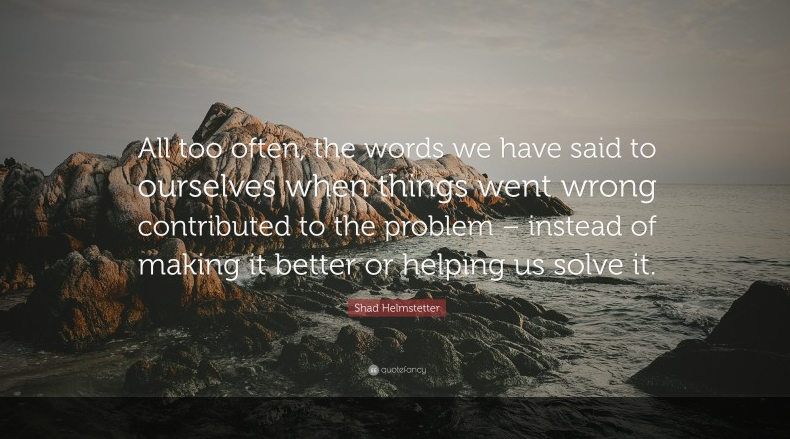
I’ve moved on from James Clear now. Next, it’s the turn of Shad Helmstetter, PhD, and an international best-selling author. In particular, his book, What to Say When You Talk to Yourself. This is one of my favourite books, for the simple reason that I believe that what we say to ourselves throughout each and every day goes towards determining the quality of our overall lives.
I love the quote above. The words we have said to ourselves when things went wrong contributed to the problem – instead of making it better or helping us solve it. I’m totally on board with this. Words are what we have to navigate our way through life – could we sometimes make better choices that might yield better outcomes?
Shad Helmstetter’s book is one of the most influential works on the power of internal dialogue and how it shapes our behaviour, confidence, and long-term outcomes. Helmstetter argues that much of what limits us in life isn’t external circumstance—it’s the automatic, often negative self-talk patterns we’ve absorbed over the years. His central message is simple but profound: if we can rewrite this internal script, we can redirect the course of our lives. If we think about it, we know we can’t control all of the external events that happen to us in life. Some of us will face redundancy, caring for elderly relatives, money worries, whilst others might face exam pressures, relationship fallouts and much more. A lot of this happens through no fault of our own – it’s that thing called life. But what we can control is how we deal with it. We can develop our thinking and self-talk to deal with the problem in a constructive and positive manner.
So how does this link back to motivation in retirement then?
Positive self-talk can help provide internal encouragement and a sense of direction. By using supportive, realistic phrases such as “I can make progress one small step at a time” or “I choose activities that energise me,” retirees can shift their mindset from obligation to opportunity. This gentle self-guidance helps overcome inertia, making it easier to start tasks, build new habits, or re-engage with activities that once brought joy. It’s so interesting how the power of what we say can affect our behaviour.
Self-talk also helps counter the common emotional barriers that affect motivation in retirement—such as self-doubt, fear of trying something new, or the belief that it’s “too late” to develop a skill. (It’s never too late, of course – something I will continually bang on about on this website). Replacing these thoughts with more empowering alternatives (“I’m capable of learning at any age” or “I deserve to invest in myself”) builds confidence and encourages action.
Additionally, positive self-talk reinforces identity during a time when roles and routines are shifting. By telling yourself, “I’m someone who stays active and engaged,” you create a mental framework that supports motivation and purposeful living.
It’s important to stress that repetition is key here. Telling yourself something once and then forgetting about it will not promote behaviour change. A jolly shame, but that is the reality. Consistency is what is needed here. Positive self-talk is about ongoing mental conditioning. Helmstetter compares it to physical exercise—you build strength through repetition. He recommends writing down your new self-talk scripts, recording them, and listening to them daily. Whichever way you do it is fine. Writing them down is one way, but you don’t have to do that. Just make it a habit of using encouraging self-talk to deal with the issues that life will inevitably throw at you. Developing awareness of any unhelpful thoughts is a good skill to learn. As soon as you become aware of a thought that is plainly not serving you, replace it with a constructive alternative straightaway. For example, swapping “I’ll never get this right” with “I am learning, improving, and capable. The more you do this, the more you and your brain will get used to this new way of thinking. This links back to neuroplasticity, which is the brain’s ability to adapt and change. I have seen it myself – my thinking now is so different to what it was, say 5-10 years ago. And this, I strongly believe, is because I have developed the skill in nurturing my self-talk into a more positive direction.
Overall, Helmstetter’s approach helps people build confidence, reduce anxiety, break unhelpful habits, and create a more supportive inner voice—one that helps rather than hinders. Who wouldn’t want a piece of that pie?
Right, where are we at? Three down, two to go – where are we going next then?

4. What might your future self think and feel?
One of the great things I love about being alive is that I have a future. Granted, I don’t know for how long, but there is definitely one there ready and waiting for me. And the same, of course, can be said for you. But how often do we fast-forward with our imaginations to the future and try and gain an idea of how we might think and feel?
Something I have exposed myself to a little to in life is Neuro Linguistic Programming techniques (NLP). Neuro-Linguistic Programming is a psychological approach that explores the connection between how we think (neuro), how we communicate (linguistic), and the patterns of behaviour we produce (programming). It’s based on the idea that by changing our internal language, mental imagery, and habitual responses, we can change how we feel and act. NLP provides practical techniques—like reframing, visualisation, and future-pacing (what!?) that help people break unhelpful patterns, build confidence, and move toward their goals with more motivation and clarity. Let’s delve into this a little and see how it can help motivate us during our retirement years.
Just realised – I’ve not done a quote on this post yet. Come on then, let’s bring one on.
“If my mind can conceive it, and my heart can believe it — then I can achieve it.” — Muhammad Ali
So here I see this quote as a mixture of creating the thought in the first place, then believing what you are thinking, can help you towards your goals in life. Like a lot of things, fairly straightforward in theory, slightly more challenging to bring into practice. Let’s look at some Neuro Linguistic Programming techniques to see how they could help us.
One of the most widely used NLP techniques for building motivation and direction is future pacing—the practice of mentally transporting yourself into a point in the future and imagining what you will think, feel, and experience if you take certain actions today. This technique works because the brain responds emotionally to vivid imagery, and when you create a compelling future in your mind, you begin to feel naturally pulled toward it rather than pushed by effort and discipline alone.
This does make sense to me. For me, as it stands, I would like to lose some weight. Thinking about what I might say to others, or indeed what others might say to me, in say 6 months, can be a motivational pull. Just letting your brain allow yourself to step forward into the future and contemplate what you might say to yourself (back to self-talk again) or feel, could motivate you to take the actions today that will support you. I understand that we are told a lot to live in the present – and that’s a good thing – but I don’t see the harm in creating some thoughts about what we might think and feel in the future if we achieve a certain aim.
Another technique is the “as if” frame, where you temporarily act as if you are already the future version of yourself. Retirees can use this by asking, “If I were already confident, active, and engaged, what would I choose to do today?” Acting from this future identity helps bypass hesitation and boosts self-belief, making it easier to take small steps forward. I strongly believe we have the ability to create our own narrative – it comes down to the words we choose. This links back to Shad Helmstetter’s work on self-talk. If we can ask ourselves more empowering questions, then we can train our brains to come out with answers that will serve us in a more positive manner. I see no harm in giving that a try.
For retirees, these NLP techniques are particularly powerful because they help rebuild a sense of purpose after leaving the structure of working life. Imagining an inspiring future—one filled with activity, learning, connection, and wellbeing—creates an emotional pull that makes action feel meaningful rather than forced.
For those of you who would like to delve a little deeper into Neuro Linguistic Programming, here is one resource that gives you a little more meat on the bones.

5. Set Meaningful, Values-Based goals
My apologies. At some point, I was always going to put a picture of a football goal in whilst talking about goals. It’s out of my system now, so be assured this is a one-off.
One of the most powerful ways to stay motivated in retirement is to set goals that align with your personal values. Research in positive psychology shows that people are far more likely to sustain effort and find enjoyment when what they do resonates with what truly matters to them—not just what they feel they “should” do. For retirees, this approach can transform daily activity from a chore into a source of purpose, connection, and fulfilment.
You can start by reflecting on what you value most. Is it maintaining your health, strengthening relationships with family and friends, or contributing to your community? It can be all three, by the way. Values can be broad, like “wellbeing” or “learning,” or more specific, like “spending time with grandchildren” or “joining a local art class.” The key is to identify goals that feel meaningful on a personal level, rather than externally imposed.
Once you have clarity about your values, translate them into actionable goals. For example, if you value health, a goal might be walking 20 minutes every day, attending a gentle yoga class, or trying a new sport with friends. If social connection is a priority, your goal could be joining a local club, volunteering, or organising regular meet-ups with friends. The activity itself becomes intrinsically motivating because it supports something that matters deeply to you.
Values-based goals also provide a mental anchor during moments of low motivation. It’s easy to skip an activity when it feels like an obligation, but when you remember the reason behind it—your health, or joy in connection—you are more likely to follow through. Studies do show that people who link actions to their core values experience higher satisfaction, resilience, and long-term engagement.
Ultimately, setting meaningful, values-based goals in retirement isn’t just about staying active—it’s about creating a life that feels purposeful, joyful, and authentic. By aligning your actions with your deepest priorities, you invite motivation to become a natural part of your daily life, helping you thrive in this exciting new chapter.
A Gentle Closing Thought
Motivation after retirement doesn’t always look like enthusiasm or high energy. Often, it looks like a small movement. Gentle intention. A willingness to try. Aspects that James Clear wrote about in his book, Atomic Habits.
Be patient with yourself.
A meaningful life in retirement isn’t built from big breakthroughs — it is built from little rhythms repeated with kindness. You’re not trying to prove anything anymore. You are learning, exploring, listening, and rediscovering who you are without the roles you once carried.
And that is a beautiful and worthwhile journey.
This is part 1, by the way. Why? Because there is so much more to unpack about this important subject in life. Motivation is a key concept in how we move ourselves forward in life. The more ideas we can put forward, the better. If you have any ideas on what you would like incorporated in part 2, please put them below. I have got ideas myself – promise – but I’d love to hear your own thoughts. As Nine Inch Nails once said, ‘We’re in This Together’.