
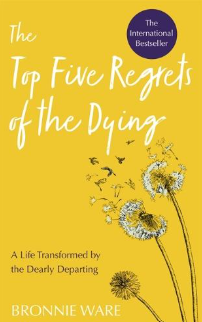
This post is inspired by the wisdom shown in Bronnie Ware’s book ‘The Top Five Regrets of the Dying’, published in 2011. For those who may not have come across this individual before, Bronnie Ware is an Australian author and motivational speaker. She used to write a blog where she recorded the dying epiphanies of her patients. This blog garnered a lot of attention, so much so that she decided to put her findings into a book – hence ‘The Top Five Regrets of the Dying’ was born.
What Bronnie Ware found were common themes being shared by those in the final throes of their lives. And those themes were not related to money, possessions, success or achievements. There were regrets about love, authenticity, happiness and human connection. Let’s explore each, share some thoughts, and – most importantly – consider how we might avoid repeating them. Because if there is just one goal I would love for this post, that would be that we take a look at our own lives, see if any of these regrets could be playing a part for us right now, and look to make some changes. The worst thing would be if, in 100 or so years, we are all coming out with the same or similar regrets. We mustn’t allow that. We must learn from those who have gone before us. I’m not saying we live a regret-free life – that would be nigh on impossible – but let’s make sure that as generations pass, the regrets at least are different. Let’s use the wisdom of others to improve our own lives, create our own new regrets, and let others learn from them as time goes on. I think that last sentence makes sense!
A quick disclaimer on this post. Most of my posts are tailored more specifically for those in retirement; I mean, the name of my website probably gives this away! But in this instance, although this post is still tailored for retirees, the content is also applicable to those of any age, really. After all, we can look to prevent or at least reduce the possibility of regrets at any point in life.

Regret Number 1 – “I wish I’d had the courage to live a life true to myself, not the life others expected of me.”
The most repeated reflection Ware heard is about authenticity. Many people said they spent their lives trying to fulfil others’ expectations, rather than follow paths they would have preferred. They pursued careers for reasons such as prestige or because it was what a parent wanted them to follow, rather than follow their own hearts and choose what they desired. They stayed in relationships out of obligation or suppressed their true desires because they feared judgment.
A Forbes article from 2021 showed that 65% of respondents worked in the field their parents ideally wanted them to head in. To me, this is quite a high figure. My personal view is that parents should be there to guide, give advice, but ultimately allow their children to make their own choices. Now, fair enough, if your child decides that they want to become a bungee jumper influencer or base jumper extraordinaire, you may want to sit down and have a few words with them, but I’m pretty sure most kids won’t opt for that sort of route.
I think it’s a shame that people can spend the biggest part of their lives working a career that is the wish of others, rather than themselves. All this time is being wasted just to make someone else ‘pleased’ about the path you have chosen. It just doesn’t sit right with me. I understand that people face pressures from others, and in some cultures and/or families, there are expectations of what their children should be doing, but I still feel it should be down to the individual to decide. It’s their life after all.
So what does living a life true to yourself really mean then? My view is that it’s about honouring your own values, your own desires and dreams, even if they don’t fit into societal or family expectations. This can take courage. Standing out from the crowd for something you believe in, creating your own unique identity and following your own passions, even if others disagree or try to put you off, can be daunting. But those who live this way often find an inner peace and deeper fulfilment, because they are no longer performing for approval, but living in alignment with their true self.
Time for a Steve Jobs quote.
“Your time is limited, so don’t waste it living someone else’s life.” – Steve Jobs
Couldn’t agree more with that. We are our own individuals. Yes, others have influence over us, whether that be parents, loved ones or friends, but we should be free to make our own choices in life, whether that be our appearance, our career, our tastes – anything that makes us the unique individual that we truly are.
Reflection for retirees. In retirement, this particular regret can be an opportunity for reinvention. It’s never too late; it really isn’t. Ask yourself:
Am I living in a way now that truly reflects what I value?
Are there passions or dreams I have always wanted to pursue but didn’t due to the opinions of others?
If fear of failure, judgment or change is holding me back, what small step could I take today to follow my own heart?
Let’s start living a life true to our own desires. Become the ‘true you’, the person you were meant to be, in the way you look, the things you do, and the values that you hold.

Regret number 2: “I wish I hadn’t worked so hard.”
Men often voiced this regret more than women, but it’s common either way. Many wish they had spent less time chasing career success, accumulating money, or meeting other people’s standards – and more time enjoying relationships, experiences and simple joy. Money is important, granted. It enables us to have choice in life, so of course, we do need to work to obtain this. But could it be that some of us get this balance wrong, and put all our energy into work/career/wage packet, at the expense of arguably other pleasures in life, such as our relationships, pastimes, or even just plain relaxing?
I think it can be easy to get consumed by work responsibilities. We get pressure from bosses to perform, and we’ve constantly got one eye on the bank account, as we need to keep that constant flow of money coming in. Some of us have deadlines to meet, performance metrics that we might need to improve on. Others may work in environments where staff shortages are common, so we take on more to try and keep the ship afloat. So it’s understandable how we can fall foul of working hard, as there is a lot of importance placed upon it.
Having a good work-life balance, though, is essential for maintaining overall well-being and happiness. Being constantly in work mode can lead to stress, unhappiness, and, in some instances, even burnout. A healthy work-life balance helps you to recharge both mentally and physically, which ironically will likely make you perform better in your job. Stress levels will be lower, there will be more clarity in your thinking, with better focus on the job at hand.
And it’s not just your job that will benefit from a recharge. Work-life balance also plays a vital role in maintaining strong relationships. I remember going on a training course for my work around 11 years ago now. For reasons I now cannot remember, delegates were asked what some of their regrets were during their working life. A good 4 or 5 people said the same – they wished they had spent more time with their children whilst they were growing up, rather than being consumed by their job. There were about 15 of us on the course, so nearly a third said the same thing. A shame. It’s difficult. Sometimes it can be after the event, before we notice that time has flown by, and we haven’t dedicated as much time to working on our relationships as we would have liked. Some of us may still have the opportunity to make changes here – for others, the time may have passed, but remember, regardless of your own individual circumstances, the majority of us, whatever our age, have relationships we can try and nurture. The future is always unwritten – you can design it the way you wish.
Maybe it’s not all doom and gloom, though. A 2023 report by Hays revealed that 56% of employees are willing to accept a lower-paid job in exchange for a better work-life balance. This is encouraging to see, and maybe it is a small sign of a step in the right direction.
Reflection for retirees: You’ve reached the season of life where balance finally matters above all. Reflect on:
What activities truly nourish my soul?
Who in my life deserves more of my presence? I like that question. It’s a reminder that we all have something to give, and that we can benefit others with our kindness, wise words, company, whatever it may be.
What in 5 or 10 years might I regret if I don’t take action now?
Remember, if the regret doesn’t speak to you at this moment, as it may not feel too important to you in the here and now, how might it feel in 10 or 20 years? Some food for thought there – pop your mind into the future and see what conclusions you might draw.
“Nobody ever said on their deathbed ‘I wish I’d spent more time in the office'” – Anna Quindlen

Regret number 3: “I wish I’d had the courage to express my feelings.”
This third regret can lead to feelings of bitterness. Many people say they suppressed their emotions to keep the peace, only to suffer later with regret or resentment. This is a bit of a tricky one, I think. Sometimes it can be beneficial to suppress your thoughts, as ultimately you could have a fallout with a loved one or a friend that you also come to regret, either at the time or later on in life. I think this example is all about context. Each situation is unique; it just requires careful thought on how you deal with it. But I see good reason to mention it – sometimes welling things up inside is not good for us, so expressing how we truly feel or think about a situation can sometimes be beneficial.
The part I want to touch on here, though, is expressing our feelings with our loved ones. I appreciate that not all of us have harmonious relationships – statistics show that to be the case – but for those of us who have a healthy connection with our nearest and dearest, should we be telling them more about how we feel about them?
And yes, it won’t surprise you too much, there is some research on this!
A 2021 survey found that only 43 per cent of British people said ‘I love you’ to their partners on a daily basis. Reasons given for not sharing our feelings in this way are that it feels ‘awkward’, or it’s just not the way things were done in their own family. I get this to a certain degree, but I also question how awkward this really should be. Although ‘I love you’ are three very important words, they are just that – words. We’re not being asked to scale Everest or build the next shuttle to fly to the moon. We’re just looking at saying a couple of words to someone who is special to us and is dedicating their life with us. Should it really be that difficult to find those three words, if not daily, well, just a few times a week? I’ll leave that one with you (comment below if you wish), but like with any habit, the more you say it, the easier it becomes to say.
Why else might we hold back on sharing our true feelings in life? For some, it could be the fear of rejection. That’s understandable. We all want to feel wanted and liked after all. But could we reframe our thinking around this, and rather than seeing rejection as a failure on our part, see it that we had the bravery to speak up and share our true feelings, regardless of the outcome? We all crave external validation, but maybe re-considering our own strengths and looking inward to continue becoming a better version of ourselves could be more helpful. We can control that side of things – we can’t control how others respond to us. So rather than fearing rejection, acknowledge it as an outcome that could happen, and if it does, work on accepting this and move on. And if rejection doesn’t happen, and you get what you were seeking, well, time for a party, I think.
Reflection for retirees: It’s never too late to speak your truths or to make amends.
Are there conversations you are avoiding out of fear?
Are there words you wish you had the courage to say, but have avoided over the years, possibly out of fear of embarrassment or ridicule?
What would it be like to live your life without carrying hidden hurts?
Maybe consider writing a heartfelt letter to someone important. In some respects, it doesn’t matter if you send it. Just the act of writing can bring clarity, closure and peace for you. Healing a fractured relationship could add profound meaning to your retirement.
“There is no greater agony than bearing an untold story inside you” – Maya Angelou

Regret number 4: “I wish I had stayed in touch with my friends”
How many of us go through life with this regret, I wonder? I look at my own life, and this has very much happened to me. I’m sure I’m not the only one. If you have experienced this, it’s very much understandable. Life often pulls us in different directions. Careers, family obligations, relocations, hooking up with a new partner and the constant rush of day-to-day responsibilities can make keeping in touch seem daunting. We all know how quickly time passes – how many of us at some point have said, ‘Well, where did that year go?’ Or even, in my case, ‘Where did the last five decades go?!’ And the thing is, before we know it, it may have been months or even years since we last made contact with a particular friend.
I get it. Some might say (ooh, Oasis time) that if they were a true friend, you would have kept in touch. I don’t see it that way, though. As mentioned, life can get in the way sometimes. It doesn’t mean your friendship isn’t strong; it’s just that other factors have come into both of your lives that have changed your priorities. That’s pretty natural. We only have 17 or so awake hours each day. We have to adjust. The way we spend our time differs as the years pass, and because of this, some things have to go. Sadly, it’s all too common that friendships are one of those aspects of life that fall by the wayside.
This regret carries an important lesson. It reminds us that relationships, all relationships, require intention. Reaching out doesn’t have to be complicated – it can take just one sentence to start the reconnect process. And these days, with the way modern technology is, getting in touch is easier than ever. Video calls, social media and messaging apps all provide tools to keep those bonds alive. Try these for a starter for ten.
“Sorry, it’s been so long – life has got in the way. Just wanted to touch base and see how you are?”
“I came across some old photos of us, and it brought a smile to my face. How have things been – are you keeping okay?”
Okay, how about injecting a small dose of humour into it?
“I was thinking it’s been ages since we last spoke – let’s fix that before we start to need walkers to meet up”
“Guess who suddenly remembered that you exist?”
“Rumour has it we were great friends once – let’s test that theory again”
Look, a certain element of silliness there, I agree, but the idea is that it can take just one sentence to reconnect with a lost friend. We don’t always know how they are going to respond – this links back to regret number three of not expressing our feelings – but if we don’t try, we just don’t know. Let’s not consider the outcome at this point; let’s just go for it and try and instigate that reconnection. Like with many things in life, it’s never too late. And who knows what your long-lost friend might be thinking. Your message to them could be a much-needed tonic for them and could make their day.
Reflection for retirees: As social circles shift in retirement, friendships are more precious than ever. Consider:
- Which friendships have I neglected?
- When was the last time I reached out to an old friend?
- How can I invest in deepening the relationships I still have?
We have more time in the post-work years of our lives to rekindle those old friendships. A simple message or call can bring back laughter, memories, and meaningful connections. Don’t wait — reach out today and let those friendships light up this next chapter of your life.

Regret number 5: “I wish I had let myself be happier.”
Happy talkin’, talkin’, happy talk. Talk about things you’d like to do.
Well, it’s been a while since I’ve thought about Captain Sensible. Amazing what memories writing a blog can bring back.
Happiness. How do we know in life if we are truly happy? We could go quite deep on this, look at what happiness is, try and understand how we seek true happiness, but I don’t think I will be able to do it justice in around 400 words. A topic to maybe explore a little more on another day. But we do need to consider how we can achieve happiness, so let’s delve a little into it.
Happiness isn’t necessarily found in the grand achievements – the promotion, the new house, passing an exam, to give a few examples. Yes, we will get a certain level of joy from here, but this will likely reduce over time. I mean, when I got a C in Economics at A-level, I remember being quite chuffed as I never thought I would get a pass, but it’s fair to say that 31 years later, that level of cheerfulness has somewhat reduced. I’ve just got thoughts now of me skipping up our road later today, still full of the joys of spring from getting that C grade. Time to move on!
Seeking happiness begins with awareness, noticing the small joys in life, such as a smile from a stranger, the sounds of birds singing outside your window, or even a nice hot drink with a loved one or friend. There are, of course, many more. At the time, these small moments can seem minor, but it’s funny. As you progress through life, they seem to become more significant, especially when you reflect on some of the good times you’ve had. They build up, and rather than just being isolated events, you start to view them all as a package. All those times you spent in a cafe with a loved one or friend, or all the mornings you woke up, stepped outside, and did nothing else but listen to the sound of wildlife around you. Not just single moments, but a part of who you are, and how you spend your time. Massively important.
For me, I have learnt to reflect and look back on my life, and regularly do so. I’m 52 as I write this blog, but I can safely tell you now that the happiest moments of my life haven’t been promotions, our first house (still in it now) or the nice new car (which is now turning into a shoddy, old car). It’s been about the conversations I have had with my family, friends and work colleagues. It’s been about being there to provide support and help to others when they have needed it. It’s been about sitting on the balcony of our caravan (not our own, I hasten to add – one borrowed from Haven for a week) and admiring the view whilst having fun chats. You’ll read and hear this a lot. It always seems to come back to one simple thing. Happiness can come from the simple aspects of life that we might often take for granted. Not sure about you, but this seems far easier to me. I’d rather that my joy in life was obtained from the simple pleasures, rather than trying to chase that promotion or have the biggest house in the neighbourhood. Too much vacuuming for one thing, and I’d probably have to spend more time than I would like in the garden. Not ideal for someone who can’t tell the difference between a rose and a Rhododendron (That last sentence wasn’t entirely truthful!)
Happiness is not something ready made. It comes from your own actions – Dalai Lama.
Absolutely. The connection between our actions/behaviours and our resulting feelings and thoughts has become so noticeable to me over the years. If I have a sluggish day, doing very little, avoiding tasks I’d set out to achieve, I feel quite ropey, tired, and just pretty low. If, however, I have a productive day, achieve what I wanted to, got my daily steps in, ate well, listened to a few top-quality albums, then all is good in the world. I can’t underestimate the link between what we do (our actions) and how it makes us think and feel. If we can sort these three aspects out in life, things are going to be a whole lot better.
So what is happiness? Well, hopefully I’ve given you a few ideas, but for one, go out there, get yourself a C-grade at A-level Economics, and pat yourself on the back for the next three or so decades!

Final Thoughts: Living With No Regrets
Few of us get an end-of-life checklist from the dying themselves, but thanks to the work of Bronnie Ware, we can hear their regrets today — and choose a different path tomorrow. Retirement isn’t about slowing down or stepping back; it’s about stepping deeper into the life that matters most.
The whole idea of this post is that we learn from the wise who have gone before us. As I stated at the beginning of the post, not all of these regrets will resonate – perhaps none of them do. But you may have your own, and the idea is that you recognise this and, regardless of your age, take steps to alter the situation. It sounds a little daft, I know, but regrets will always likely be a part of human existence – we have to accept that – but if we can try not to repeat the same regrets that those who have gone before us have had, we are then progressing. We may develop our own regrets – that’s understandable – but the idea is that any new regrets we share, those that are younger than us (the lucky so-and-so’s) can heed our own wisdom and ensure the same doesn’t happen to them.
Life. It’s a funny old thing, isn’t it? I hope this post was an enjoyable read, and got the grey matter working. Change can always be made – all we have to be is alive to be able to make it happen. And if you’re alive and reading this, well, you’re one of those who can make the change.